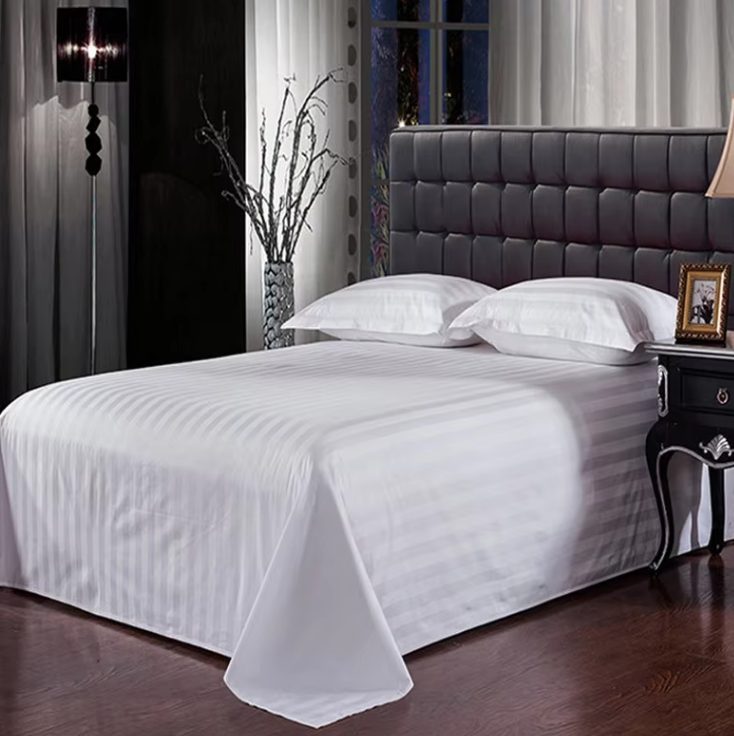
What hotel housekeepers notice before guests do
A cotton bedding set often gets judged in the first thirty seconds of a hotel stay, but not by thread count. Guests notice whether the duvet cover feels cool or clammy, whether the pillowcase grabs at hair, and whether the sheets smell faintly of detergent or plastic. Housekeepers notice something else: how the bedding behaves after fifty commercial wash cycles. That split perspective explains why 100% cotton bedding keeps winning in both hotels and homes. It is not a luxury story. It is a material story about moisture, hand feel, and how fabric ages.
Cotton is a natural cellulose fiber with a moisture regain around 8 percent under standard conditions, compared with roughly 0.4 percent for polyester. That means cotton can absorb a small amount of moisture from the body and release it gradually, which keeps the sleep surface from turning into a plastic sheet. The effect is modest, but sleepers feel it. In humid rooms, the difference between cotton and microfiber becomes obvious by 2 a.m.
Breathability is the real reason cotton sleeps cooler
Breathability gets marketed as a vague comfort word. In bedding, it has a mechanical basis. Air moves through the gaps between yarns, and moisture vapor passes along the fiber surfaces. A tightly woven cotton can still breathe because the fiber itself manages moisture. A synthetic fabric can be brushed soft and still trap heat because the filaments do not absorb vapor the same way.
That is why a cotton bedding set is common in hotels with central HVAC and in homes without it. The fabric buffers small temperature swings. It does not magically cool a room. It simply avoids the clammy feeling that builds when moisture has nowhere to go. For hot sleepers, that distinction matters more than a high thread count claim.
Durability under commercial laundry: where cotton earns its keep
Hotel laundry is brutal. Sheets go through industrial washers, high-temperature drying, and repeated folding. Blended fabrics often look crisp at first and then pill or develop a slick feel. Long-staple cotton holds up better because longer fibers can be spun into finer, stronger yarns with fewer exposed ends. The result is less pilling and a surface that stays smooth after repeated washing.
A procurement team for a 180-room hotel near the southern coast once tested two bedding programs over one rainy season. The first used a poly-cotton blend. The second used a 100 percent cotton bedding set with a percale weave. By month four, the blend showed visible pilling along the pillowcase edges and a slight shine on the flat sheets. The cotton program showed some softening but no pilling. The cotton option cost more per set, yet the replacement rate dropped enough to narrow the gap. That is the kind of data that changes a purchasing decision.
| Bedding option | Moisture regain | Breathability | Pilling risk after repeated washing | Hand feel over time | Typical hotel laundry life |
|---|---|---|---|---|---|
| 100% cotton percale | About 8% | High | Low with long-staple fiber | Softens, stays dry | 2 to 3 years |
| Poly-cotton blend | About 3% | Medium | Medium to high | Can feel slick | 1 to 2 years |
| Microfiber polyester | Under 1% | Low | Low pilling but traps heat | Stays smooth, can feel clammy | 1 to 2 years |
| Cotton sateen | About 8% | Medium | Low to medium | Smooth, heavier drape | 2 to 3 years |
Industry standards help buyers compare apples to apples. AATCC 135 covers dimensional changes after home laundering, and ASTM D3776 provides a consistent method for fabric weight per unit area. Those numbers do not tell the whole comfort story, but they make supplier claims easier to verify.
The comfort trade-offs nobody puts on the spec sheet
Cotton is not automatically better in every category. It wrinkles. It takes longer to dry than polyester. In a home with a small dryer, a thick cotton bedding set can be a hassle. Cotton also varies widely by fiber length and origin. Short-staple cotton can feel rough and pill quickly, even when the label says 100 percent cotton.
There is also the sateen versus percale question. Sateen has a smoother, heavier hand and a subtle sheen, which many hotels like for a polished look. Percale is crisper and more breathable, which suits hot sleepers and humid climates. Neither is superior across the board. The right choice depends on the sleeping environment, the laundry setup, and the visual standard the property wants to project.
How thread count, weave, and finish change the story
Thread count is the most abused number in bedding. A very high count can come from multi-ply yarns counted twice, which tells a buyer little about hand feel. Weave matters more. Percale, sateen, and twill each produce a different surface and airflow pattern. Finish matters too. Softening washes and mechanical finishes can improve the first touch, but heavy chemical finishes may reduce breathability.
For buyers sourcing at volume, the practical move is to ask for fabric weight, yarn type, weave, and shrinkage data rather than relying on thread count alone. A cotton bedding set with clear specs is easier to audit than one with a vague premium label.
Jianhong works across bedding and bathroom textiles with integrated manufacturing and quality control. For procurement teams, that setup makes it easier to keep weave, fiber length, and finishing details consistent from one order to the next.